-
The Build Back Bio story 3
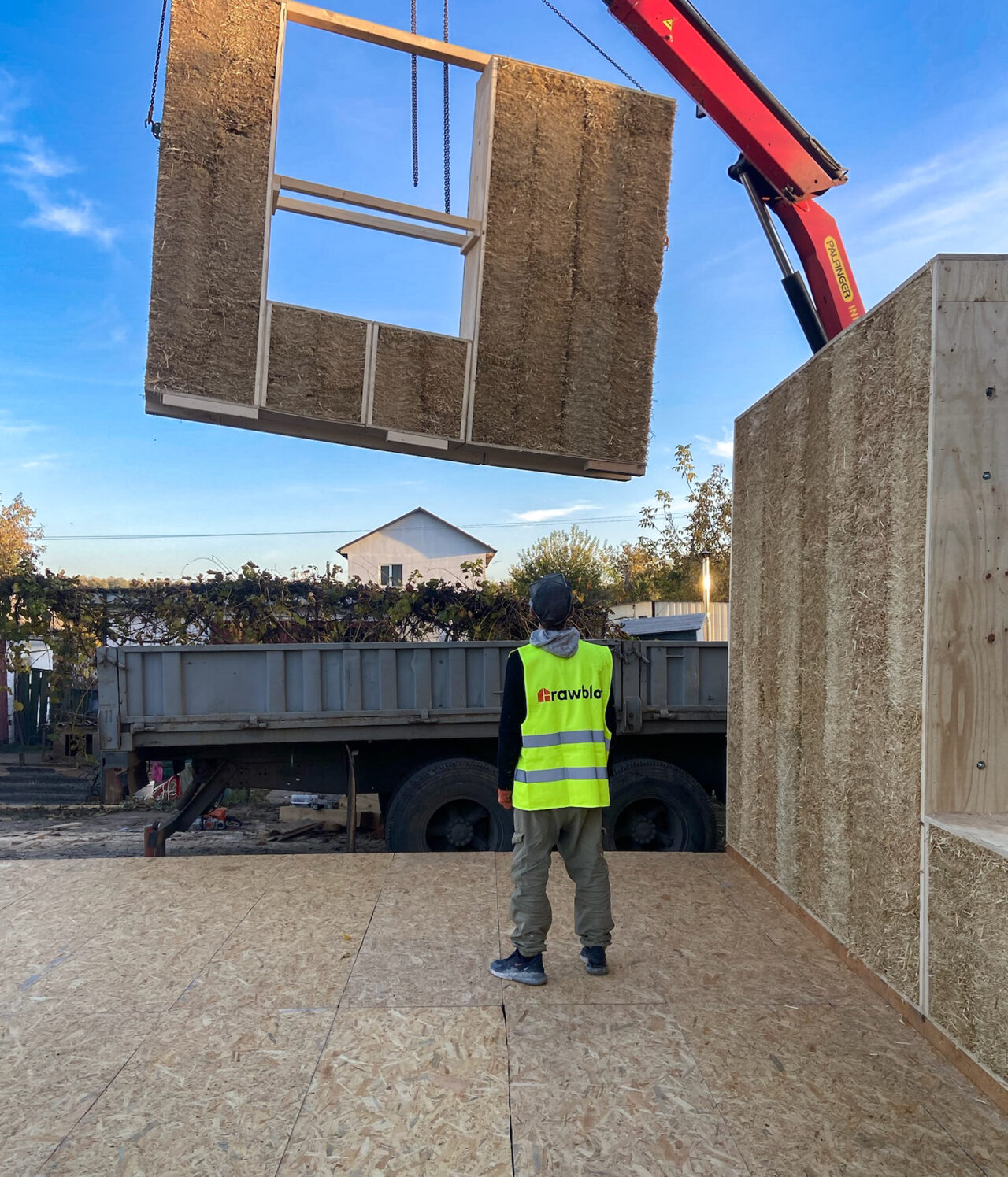
A thriling tale of innovation, entrepreneurship, and daring: that’s Build Back Bio’s story. In our Build Back Bio series, learn what brought an engineer, a biologist, and a businessman together with the aim of revolutionising Ukraine’s construction industry while contributing to its reconstruction.
Build Back Bio will build 450 homes in Ukraine over the next 3 years.
To give you an idea of scale, large construction companies in the Netherlands can produce around 1,000 houses a year[1]. Build Back Bio, comprised of two companies a fraction of the size of industrial construction companies and one NGO, will build almost half as many as this, in a country at war.
350 of these homes will be completed to ‘casco’ level, which means they will be made wind and rain proof, but not fully furnished and finished. This will be for those families and individuals who couldn’t afford a home, but can afford to finish their home to their specifications. Build Back Bio will help them find good contractors and negotiate prices to finalise their homes.
100 houses will be fully finished and furnished. The funds to ensure this will come from the UPF fund, and are meant for families who cannot afford to put any funds towards the reconstruction of their home.
This is an ambitious goal, but it’s not the only thing Build Back Bio wants to achieve.
The overarching dream that brings the Build Back Bio partnership together is to prove that building with bio-based materials, entirely according to circular reconstruction methods, can be done at scale and at cost.
Ideally, by the end of this project, a thriving bio-based construction market will exist in Ukraine, where competitors compete and innovate. Bio-based building should become known as a safe, healthy, energy efficient, and affordable option for anyone who wants to build a house.
To get there, Build Back Bio have also partnered with PROFBUD (the Trade Union of Construction and Building Materials Industry Workers of Ukraine). PROFBUD is Ukraine’s main labour union in Ukraine fighting for safe and fair working conditions, and unites more than fifty thousand workers in the construction and building materials industry.
Together with them, Build Back Bio will make sure that all the project’s construction activity is in line with the strictest Ukrainian labour laws, emphasising safety and fair wages.
War permitting, all of Build Back Bio’s resources are currently slated to come from the local community in which it will build. Its straw will be sourced from local farmers, and the project will work with PROFBUD and the vocational school of Chernihiv to train people to operate the straw panel machine line and get involved in construction of homes. We will train anyone in bio-based construction who is interested. We are looking to understand how we can best involve individuals who have not traditionally been involved in the construction industry, including women.
Chernihiv is only the beginning. Build Back Bio will expand into other regions in Ukraine, to build houses that are safe, environmentally friendly, low carbon, and energy efficient – we can’t wait.
Thank you for reading our three-part series introducing the Build Back Bio partnership. To stay in touch, follow Rawblox, OpenDoorUkraine, and Hempire’s LinkedIn pages, where we will be posting regularly to keep you up to date.
[1] Depending on the year, company, tenders and permits awarded.
-
Living in a country at war

It’s now been 3 weeks since we’ve lived in Kyiv, and we’re starting to build a home.
We have bought a mattress and a duvet, which we have installed in our high-ceilinged apartment just off Maidan square. We’ve got candles to make it feel like home and have even bought a slightly pre-emptive Christmas gnome.
Our free time is also shaping up. We have found a Crossfit gym and even beach volleyball stadium, warmed to a balmy 20° – almost enough to make you forget that winter is definitely on the way. Running in Kyiv is also a special joy. The city is built on a collection of hills, meaning you can turn a corner and be rewarded by an expansive view of the Dnipro river and the jewel-coloured parks and woods that highlight the landscape, or you can crest a hill and marvel at the joyfully coloured homes on Andriivs’kyi Descent.
We have found our favourite coffee place that doubles as a bookstore near the office which sells excellent coffee and buckwheat tea, a typically Ukrainian drink. The bookstore has an extensive collection of books in Ukrainian and English – I’m eying a Ukrainian version of Harry Potter to supplement the Ukrainian lessons we’re following.
We now know where our local supermarket is, where I’ve become completely addicted to to plastic tubes of pickled vegetables: gherkins, incredible; pickled tomatoes, absolutely spectacular.
So far, then, so normal. We’re adjusting to living in a new place, figuring out life in a new country, language, and culture. Of course, the big difference is the war.
The war never lets you forget that it’s there. It is there when, on the drive from Chernihiv to Kyiv, you stop seeing babusyas selling mushrooms and handmade jams on the side of the highway. In their place, you start seeing unassuming small red signs featuring a white skull and crossbones. The warning signal that tells potential nature lovers that the areas has been mined is framed by exquisite autumn colours, the tracks that used to meander through the trees all but invisible through disususe.
It’s also at breakfast in Cherhihiv, when, over the clatter of cutlery and familial murmering, an explosion suddly disrupts the soft morning fog. We froze – did we have to do something? Shelter? Run and panic? Not a single Ukrainian even looked up from their plate. “Another coffee my love?” – life went on.
The war is also checking Telegram at 3 o’clock in the morning to see how to respond to the air raids. Is it shaheds, meaning we should put our mattress in the corridor again in case the windows are blown out, or is it ballistics, which means venturing outside to the metro in the dead of the cold night?
The war is acutely present when walking past Maidan square, where a spontaneous tribute to the fallen soldiers of Ukraine has sprung up. A dense forest of blue-and-yellow Ukrainian flags barely make it above the thick undergrowth of flowers that surround pictures of smiling men, some just a picture in a frame, others a banner that mention their name, their role in the army, their age.. One boy whose banner is on the square was one month younger than my brother – he died last summer. Another was nearly the same age as my parents. Every single one of these pictures on banners have left people behind that loved them as fiercely I love my family and friends. The shock of seeing it is like plunging in ice-cold water. It takes your breath away.
When people ask, then, how life is in a country at war for two newcomers, the answer is a paradox. The banality and common joy of exploring normal life in a new place is paired with absurdity, fear, and a deep sadness that normal life has been so deeply and terribly disturbed.
-
The Build Back Bio Story 2
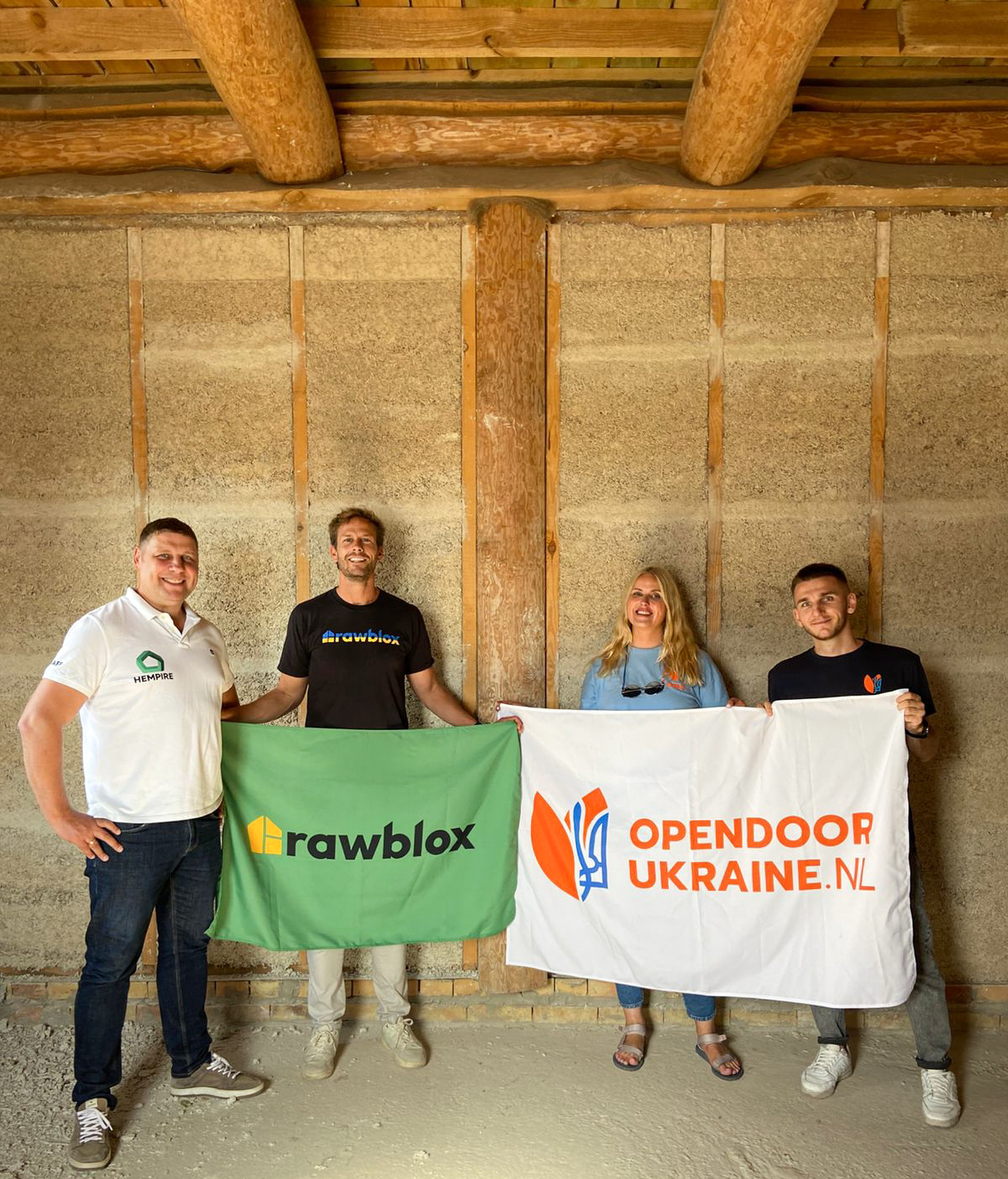
A thrilling tale of innovation, entrepreneurship, and daring: that’s Build Back Bio’s story. In our Build Back Bio series, learn what brought an engineer, a biologist, and a businessman together with the aim of revolutionising Ukraine’s construction industry while contributing to its reconstruction.
After discovering their shared vision for Ukraine, Daan and Julia needed to prove that they could operate in the country. That meant finding a Ukrainian construction partner.
They found Serhii Boiko. Serhii is the CEO of the largest hemp-crete builder in Ukraine as well as the head of the Hemp Builders Association. Hemp-crete is a bio-based building solution that mixes hemp and a lime-based binder to create lightweight, insulating, carbon-negative material used for walls, floors, and roofs, which allow you to build breathable, safe, and well-insulated houses. It pairs well with straw-based building methods.
Serhii is from the southwestern Vynnytsia region of Ukraine, known for its food, beautiful scenery, and good quality of life. When the war broke out, Serhii was in Kyiv, staring with unbelief at the TV, where a situation that would fundamentally change his world was developing.
Whilst bombs were still falling on Kyiv and other major cities, the world was slowly learning of Russian atrocities in Bucha, and the Azovstal siege was beginning to take shape, Serhii restarted operations in April, only two months after the full-scale invasion. “Under no circumstances could I stop, there was no other option but to keep going”, he remembers.
The team set out to test and prove their project, and found the perfect opportunity. There is a small village in Chernihiv, a province in Northern Ukraine that borders Belarus.[1]
When the Russians invaded Ukraine in 2022, Chernihiv was on the original axis of invasion. It is a testament to the superhuman bravery of the army, territorial defenders, and civilians of Chernihiv that the Russians were not able to take the city.
On 6 March 2022, by decree of the President of Ukraine, Chernihiv was awarded the honorary title “Hero City of Ukraine” for its heroism and resilience in face of the Russian invasion. However, the scale of the destruction was severe. By the time the Russians were forced to withdraw from Chernihiv in April 2022, an estimated 700 civilians and armed forces were killed and around 70% of the city of Chernihiv was destroyed.
Anna is a babusya[2] whose home was destroyed during the original invasion. Since then, she has lived in temporary emergency housing. Despite her house being entirely destroyed, Anna maintains her vegetable patch next to her old home meticulously.
Temporary housing, although essential for humanitarian aid, is not built to live in indefinitely. Anna was desperate to rebuild her home.
Daan, Julia, and Serhii got to work. There proved to be a steep learning curve. Daan’s first instinct was to build a modern house with a flat roof – easy to build, easy to insulate. It seemed like the obvious approach. Anna was outraged: a Ukrainian living under a flat roof – never! Pointy roofs were the norm – Anna would take a pointy roof or no roof at all, and by the way, had the partners thought of her pickle cellar, where she would store the rich rewards of her vegetable patch?
The partners reconvened. The roofs would have to be made pointy, and considering that they would try to build on top of the old, now bombed, foundations, a pickle cellar was probably impossible. Luckily Anna confirmed that a pickle attic would prove an acceptable compromise.
The partners built Anna’s house, it’s in the process of being finalised so she can move in. They now also knew that they had tested and proved their project plan: they were ready for the UPF application.
Daan remembers exactly where he was and what he was doing when Build Back Bio was awarded a UPF grant in October 2024. He was travelling when his business partner tried to reach him on every possible number to tell him they had won the grant. However, Daan was travelling, which often means his phone is out of battery. Through a chain of key interlocuters, they finally made contact. “I knew then my life was going to change”, recalls Daan.
Join us next time for the third and final chapter introducing Project Build Back Bio. Next week: what exactly Build Back Bio will be looking to achieve in Ukraine and how it will achieve it.
[1] We are redacting the name of the exact village for safety reasons
[2] Meaning grandmother. Non-Ukrainian readers may be more familiar with the Russian form of the word, ‘babushka’.
-
“I like war”

I have never in my life met a mercenary.
That changed on a balmy late afternoon in June 2025 when we found ourselves on a square on Kreschatyk street. The square is in the middle of Kyiv, and lest you think it’s a quiet, self-contained square, let me disabuse you of that notion immediately. Kreschatyk is a four lane road with cars going both ways, flanked by pedestrians who gander in front of the kebab kiosks, bars, and high end department stores.
We were on the South side of Kreschatyk. At our small round cheap tables, we were dwarfed by The House With a Star, an imposing example of Stalinist Empire Architecture. It features its eponymous star on its highest tower, although the star may soon be gone. In 2024, the Kyiv city council decided to “remove elements of decoration that reflect soviet and russian historical and propaganda narratives”.
The reason we were at this square was being delivered out of red brick arched alcoves that made up the staircase leading up the House: Odessa oysters and bubbles.
As the light turned golden, tray after tray of testaments to Odessa’s grit and bravery come out of the shadowy stone walls, where music was starting to promise late night of revelry, inasmuch as you can get a late night with curfew.
Even the occasional air alarm didn’t stop the strides of people fanning about Kreschatyk, their unhurried pace a deliberate insult to Russia’s military capabilities.
Seated at the table next to us was a group of Spanish-speaking men. They had traded the bubbles for a bottle of tequila, and had brought a speaker that was playing bachata. Every once in a while a song was just too good and you could spy some shy dance moves on the way to picking up more food.
It’s not unusual to hear foreign voices in the Kyiv. All the big NGOs are there, embassies are well staffed, there’s even the occasional lost tourist. We struck up a conversation.
The group was made up of four men, Luis[1] was young, but he felt like the leader of the company. Extremely polite, he had an air of a gentleman soldier: he stood when he shook my hand and his slow speech was deliberate grace to my still-learning Spanish.
Two of Luis’s friends made no such allowances, speaking at a thousand kilometres an hour. Sebastian was the youngest, shy, and had suffered an injury to his right hand that had left him with two fingers that looked most like a lobster claw.
When we explained what we were doing in Ukraine, building houses from straw, one of the men interjected breathlessly, eyes as big as saucers: “Construction? I love construction, my brother is in constrution, he makes good money, you can make good money in construction, me I don’t like construction, construction isn’t as good as WAR, I like WAR, that’s what I’m good at, don’t want to do anything but WAR”.
Every iteration of “WAR” was uttered with a automatic rifle’s worth of energy.
Mercenaries get paid well in Ukraine. According to Ukraine’s Foreign Legion, a mercenary can expect to make $500 a month behind the frontline, $1200 a month for service in a dangerous zone, and up to $4600 a month for combat deployment. It’s unsure how many mercenaries are curently active in Ukraine.
I never thought to wonder what made men pack up and seek out war. The money is good, but maybe it’s just for the sheer love of it, as it seemed to be for one of the men we met.
As the long summer day definitively turned into night and the Kyiv youth claimed their right over the streets, we bade our goodbyes, and shook each man’s hand. Sebastian hesitated in giving his right hand, self-consciously hiding it in his sleeve. I held out my hand, until he gave me his, and shook it.
[1] Names have been changed to maintain anonymity
-
The Build Back Bio Story 1
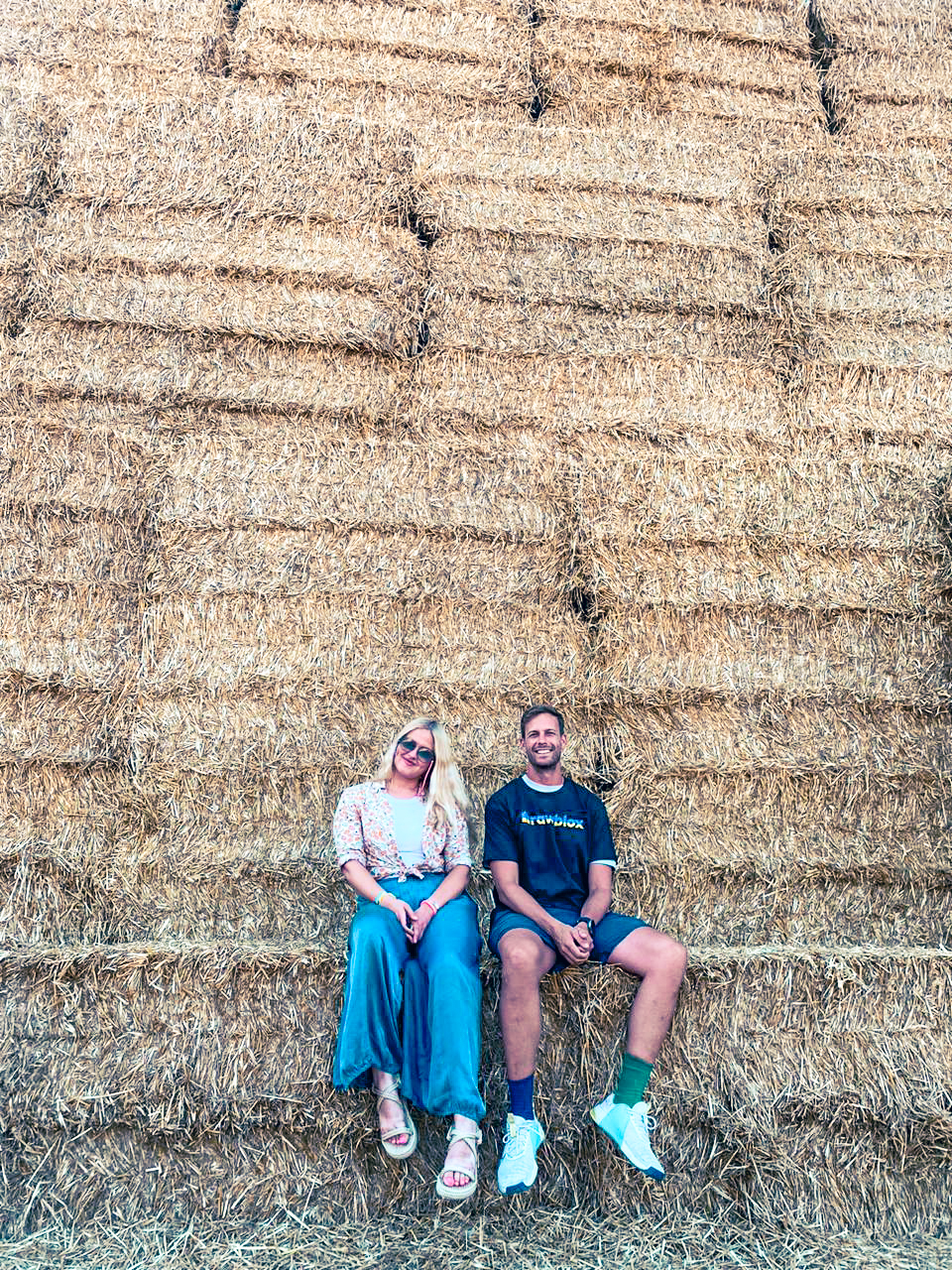
A thrilling tale of innovation, entrepreneurship, and daring: that’s the Build Back Bio story. In our Build Back Bio series, learn what brought an engineer, a biologist, and a businessman together with the aim of revolutionising Ukraine’s construction industry while contributing to its reconstruction.
It was a sunny day in the Netherlands when Daan Hartge, CEO and Founder of Rawblox got a phone call. The caller had a question: would he be interested in deploying his machine line that procudes straw panels for construction to Ukraine? Oh, and would be be able to travel to Ukraine, preferably this week, as it was needed now – there was no time to wait for the end to the war.
When asked later what his response was, Daan stated, “Yes. Just an immediate yes.” He was in Kyiv one week later.
The caller on the other side of the phone was Julia Skripka, Project Manager at OpenDoorUkraine (ODU), a Dutch-Ukrainian NGO headed by the first Dutch ambassador to Ukraine. With ODU, Julia has been actively involved in reconstruction and reparation efforts of Ukraine’s buildings and homes since the start of the war.
When the war broke out, Julia, a native Ukrainian with a background in biology, had been living abroad. Within days of the war breaking out, she had packed her bag, moved to Kyiv, and started working at ODU. “Of course I moved back”, she said, “people needed help”.
Together, Daan and Julia began to understand that they shared a vision of building homes for Ukrainians who had lost theirs as a result of Russian aggression. More than that: they wanted to build them fast, build them cheap, and build them to last.
The question quickly shifted from what they would do, to how they would it.
A clear immediate challenge was funding. The people who needed the homes the most, including women with children’s whose partner was fighting in the war, disabled veterans, internally dispalced persons or lower income individuals, did not have the disposible income to pay for the houses. And how would they import the machine line into Ukraine, and train people how to use it? Neither Rawblox or ODU had the disposible cash on hand to have the impact they wanted.
An immediate answer was Ukraine’s eVidnevlonnia system. The eVidnovlennia programme was created by the government of Ukraine to provide financial support to people whose housing has been damaged or destroyed as a result of the war. The system has been invaluable: whilst giving agency to the victims who use it, who can choose to repair or rebuild their home or move into new housing, it has also stimulated the construction sector, boosting economic activity.
That still left a funding gap, and the answer was to be the Dutch Ukraine Partnership Facility (UPF). The UPF is a funding vehicle of the Netherlands for partnerships of companies and social organizations from the Netherlands and Ukraine that want to contribute to the reconstruction in Ukraine and the sustainable recovery of the Ukrainian economy and society, and cannot do so without government support.
The fund is fully non-profit: whoever applies to the fund and is successful is not allowed to set up a for-profit business – all returns have to be invested in Ukraine.
The Netherlands is a huge donor for Ukraine. To date, the Dutch have contributed almost 9 billion euro to Ukraine (including the UPF fund), and they are continuing to do more.
A vague outline of a project was starting to make itself clear. Now all Daan and Julia had to do was to prove they could build in Ukraine, and apply to the UPF fund.
Follow us next week as we update you on exactly what Build Back Bio will do in Ukraine, how the Rawblox and ODU ended up partnering with Hempire, and how the partnership will achieve its goals. Spoiler alert: there are pickle cellars.
